Chapter III. FROM PAIN TO SUFFERING
This is a draft (July 27, 2005) of Chapter III of The Emotion Machine by Marvin Minsky. Please send comments to minsky@media.mit.edu.
Chapter III. FROM PAIN TO SUFFERING..................................................................................................... 1
§3-1. Being in Pain.............................................................................................................................................. 1
§3-2. Prolonged Pain leads to Cascades............................................................................................................... 3
The Machinery of Suffering............................................................................................................................ 5
Physical vs. Mental 'Pain'................................................................................................................................ 7
§3-3. Feeling, Hurting, and Suffering.................................................................................................................. 7
§3-4. Overriding Pain.......................................................................................................................................... 9
Prolonged and Chronic Suffering................................................................................................................. 10
Grief.............................................................................................................................................................. 11
§3-5 Correctors, Suppressors, and Censors....................................................................................................... 13
Excessive Switching..................................................................................................................................... 14
Learning from Failure................................................................................................................................... 15
Varieties of Negative Expertise..................................................................................................................... 17
§3-6 The Freudian Sandwich............................................................................................................................. 18
§3-7. Controlling our Moods and Dispositions................................................................................................. 19
§3-8. Emotional Exploitation.............................................................................................................................. 20
TRANSITION?.................................................................................................................................................. 23
§3-1. Being in Pain
“Great pain urges all animals, and has urged them during endless generations, to make the most violent and diversified efforts to escape from the cause of suffering. Even when a limb or other separate part of the body is hurt, we often see a tendency to shake it, as if to shake off the cause, though this may obviously be impossible.” —Charles Darwin[i]
What happens when you stub your toe? You’ve scarcely felt the impact yet, but you catch your breath and start to sweat—because you know what’s coming next: a dreadful ache will tear at your gut and all other goals will be brushed away, replaced by your wish to escape from that pain.
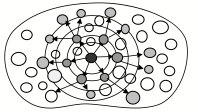
Why does the sensation called pain sometimes lead to what we call suffering? How could such a simple event distort all your other thoughts so much? This chapter proposes a theory of this: if a pain is intense and persistent enough, it will stir up a certain set of resources, and then these, in turn, arouse some more. Then, if this process continues to grow, your mind becomes a victim of the kind of spreading, large-scale “cascade” that overcomes the rest of the mind, as we depicted in §1-7:
Now, sometimes a pain is just a pain; if it’s not too intense or doesn’t last long, then it may not bother you much. And even if it hurts a lot, you can usually muzzle a pain for a time, by trying to think about something else. And sometimes you can make it hurt less by thinking about the pain itself; you can focus your attention on it, evaluate its intensity, and try to regard its qualities as interesting novelties.
Daniel Dennett: “If you can make yourself study your pains (even quite intense pains) you will find, as it were, no room left to mind them: (they stop hurting). However studying a pain (e.g., a headache) gets boring pretty fast, and as soon as you stop studying them, they come back and hurt, which, oddly enough, is sometimes less boring than being bored by them and so, to some degree, preferable."
But this only provides a brief reprieve, because until your pain goes away, it may continue to gripe and complain, much like a nagging frustrated child; you can think about something else for a time, but no matter what kinds of diversion you try, soon that pain will regain its control of your mind.
Still, we should be thankful that pain evolved, because it protects our bodies from harm. First, as Darwin suggests above, this may induce you to shake off the cause of the pain—and it also may keep you from moving the injured part, which may help it to rest and repair itself. However, consider these higher-level ways through which pain may protect us from injury.
Pain focuses your attention on the particular
body-parts involved.
It makes it hard to think about anything else.
Pain makes you tend to move away from whatever is causing the stimulus.
It makes you want that state to end, and it makes you learn, for future times,
not to repeat the same mistake.
Yet instead of being grateful for pain, people always complaining about it. "Why are we cursed," pain’s victims ask, "with such unpleasant experiences?" We often think of pleasure and pain as opposites—yet they share many similar qualities:
Pleasure makes you focus on the particular
body-parts involved.
It makes it hard to think about anything else.
It impels you to draw closer to whatever is causing the stimulus.
It makes you want to maintain that state, while teaching you, for future times,
to keep repeating the same mistake.
This suggests that both pleasure and pain could engage some of the same kinds of machinery. For example, they both tend to narrow one’s range of attention, they both have connections with how we learn, and they both assign high priority to just one of a person’s many goals. In view of those similarities, a visiting alien intelligence might wonder why people like pleasure so much—yet display so little desire for pain.
Alien: Why do you humans complain about pain?
Person: We don’t like pain because it hurts.
Alien: Then explain to me just what ‘hurting’ is
Person: Hurting is simply the way pain feels.
Alien: Then please tell me what a ‘feeling’ is.
At this point the conversation may stop, because quite a few human thinkers might claim that we’ll never have ways to explain such things, because feelings are ‘irreducible.’
Dualist Philosopher: Science can only explain a thing in terms of other, yet simpler things. But subjective feelings like pleasure or pain are, by their nature, indivisible. They can’t be reduced to smaller parts; like atoms, they simply are or are not.
This book will take the contrary view that feelings are not simple at all; instead they are extremely complex. And paradoxically, once we recognize this complexity, this can show us ways to explain why pleasure and pain might seem similar if (as we’ll try to show in Chapter §9) we can represent both of them as results that come from similar kinds of machinery. [Also, see §§Dignity of Complexity.]
People often use hurting, pain and suffering as though those conditions were almost the same, and differ mainly in degree. This chapter will argue that we need much better distinctions and theories for these.
∞∞∞∞∞∞∞∞∞∞∞∞∞∞∞∞∞∞∞
§3-2. Prolonged Pain leads to Cascades.
Our idea about how Suffering works is that any severe and prolonged pain leads to a cascade of mental change that disrupts your other plans and goals. By thus suppressing most other resources, this narrows your former interests—so that most of your mind now focuses on one insistent and overwhelming command: No matter what else, get rid of that Pain.
This machinery has great value indeed—if it can make you remove whatever’s disturbing you, so that you get back to what you were trying to do. However, if that pain remains intense after you’ve done all you can to relieve it, then it may continue to keep the resources that it has seized—and further to proceed to capture yet more—so that you can scarcely keep anything else ‘on your mind’. If left to itself, that spreading might cease—but so long as the pain refuses to leave, that cascade of disruption may continue to grow, and as those other resources get taken away, your efforts to think will deteriorate, and what remains of the rest of your mind may feel like it’s being sucked into that black hole of suffering.
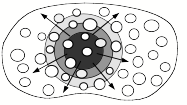
Now, goals that seemed easy in normal times get increasingly harder to achieve. Whatever else you try to do, pain interrupts with its own demands and keeps frustrating your other plans until you can barely think about anything but the pain and the trouble it’s caused. Perhaps the torment of suffering comes largely from depriving you of your freedom to choose what to think about. Suffering imprisons you.
Neurologist: These ideas about disruptive cascades are suggestive, but have you any evidence that processes like these exist? How could you show that these guesses are right?
It would be hard to demonstrate this today, but when scanners show more of what happens in brains, we should be able to see those cascades. In the meantime, though, one scarcely needs more evidence than one sees in the diversity of the complaints from the victims of suffering:
Frustration at not achieving goals.
Annoyance at losing mobility.
Vexation at not being able to think.
Dread of becoming disabled and helpless.
Shame of becoming a burden to friends.
Remorse at dishonoring obligations.
Dismay about the prospect of failure.
Chagrin at being considered abnormal.
Resenting the loss of opportunities.
Fears about future survival and death.
This suggests that we learn to use words like ‘suffering’, 'anguish', and 'torment' to try to describe what happens when those disruption cascades continue: as each new system becomes distressed and starts to transmit disturbing requests, your normal thoughts get overcome, until most of your mind has been stolen from you.
Citizen: I agree that these all can come with suffering. But that doesn’t explain what suffering is. To be sure, resentment, remorse, dismay, and fear are all involved with reactions to pain—and can help to cause us to suffer. But why can’t we just regard ‘suffering’ as just one more kind of sensation?
When we talk about ‘sensations’ we usually mean the signals that come from sensors that are excited by conditions in the external world. However here, I think, we’re talking about signals that come, not from outside, but from special resources that detect high-level conditions inside the brain. Later, in section §4-3, we’ll suggest how such resources might actually work.
In any case, when suffering, it is hard to think in your usual ways. Now, torn away from your regular thoughts, you can scarcely reflect on anything else than on your present state of impairment—and awareness of your dismal condition only tends to make things worse. Pain, as we said, deprives you of freedom, and a major component of suffering is the frustration that accompanies the loss of your freedom of mental choice.
Of course the same is true, to a smaller degree, in our more usual states of mind: our thoughts are always constrained by the goals that we hold, which try to engage different processes. Those processes sometimes cooperate, but they also frequently clash and conflict. We never have enough time to do all the things that we want to do—and so every new goal or idea that we get may make us abandon, or put aside, some other ambitions we want to achieve.
Most times, we don’t mind those conflicts much, because we feel that we’re still in control, and free to make our own decisions—and if we do not like the result, we’re still ‘free’ to go back and try something else. But when an aching pain intrudes, those projects and plans get thrust aside, as though by an external force[ii] —and then we end up with more desperate schemes for finding ways to escape from the pain. Pain’s urgency is useful to us when we need to deal with emergencies—but if it cannot be soon relieved, it then can become a catastrophe.
Indeed, suffering can affect you so much that your friends may see you being replaced by a different personality. It may even make you so regress that you cry out and beg for help, as though you've become an infant again. Of course, you may see yourself as still the same, and imagine that you still possess your old memories and abilities. But you won’t be able to use those well until you switch back to your regular Self.
The primary function of Pain is to make one remove whatever may be causing it. To do this, though, it needs to disrupt most of one’s other usual goals. Whenever this leads to a large-scale cascade, then we use words like ‘suffering’ to describe what remains of its victim’s mind.
∞∞∞∞∞∞∞∞∞∞∞∞∞∞∞∞∞∞∞
The Machinery of Suffering
“The restless, busy nature of the world, this, I declare, is at the root of pain. Attain that composure of mind, which is resting in the peace of immortality. Self is but a heap of composite qualities, and its world is empty like a fantasy.” —Buddha
“Life is full of misery, loneliness, and suffering – and it’s all over much too soon.” – Woody Allen
Yesterday Joan tripped on a step. She didn't suspect that she’d injured herself—but today she has just become aware of a terrible pain in her knee. She's been working on an important report and tomorrow she plans to deliver it. “But if this keeps up,” she hears herself think, “I won't be able to take that trip.” She tries to make herself get back to work, but shortly she drops her pen and moans, “I really must get rid of this pain.” She attempts to visit her medicine shelf, to find a pill that could bring some help, but a stab of pain makes her sit back down, and instructs her not to use that leg. She clutches her knee, catches her breath, and tries to think about what to do next—but the pain so overwhelms her mind that she can't seem to focus on anything else.
How does Joan know where her pain is located? That’s easy to do for each place on her skin—because she is born with ‘maps’ of her skin in various different parts of her brain, like this one in the sensory cortex.
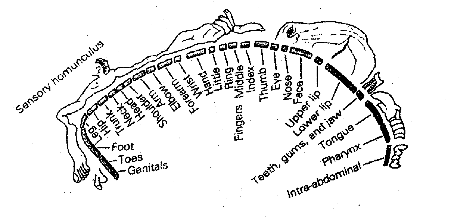
www.sm.luth.se/.../ Sensory%20homunculus.png
Many textbooks about the brain explain that those maps help us to determine the locations of tactile sensations—but those books don’t ask what advantage we gain from having those maps—considering that the skin itself could serve for that. (We’ll discuss this in TopoQualia.) However, we are not nearly so good at locating the causes of interior pains. It seems that our brains do not come equipped to represent the locations of structures inside our skins. Presumably, good maps for these have never evolved because they would not have been of much use to us: before the era of medicine, there was no way to protect one’s spleen, except to guard one’s whole abdomen—hence all one actually needed to know is when one had a bellyache. In particular, one never says, "I feel a terrible pain in my brain,” because we never had any remedies for injuries to the brain itself—so we never evolved any sense of pain in our brains, or of the spatial locations of mental events.
In any case, for Joan's pain to be useful to her, it must make her focus her thoughts on that knee—while also postponing her other goals. “Get rid of Me,” Joan’s pain demands, “and get back into your Normal State.” She won’t be able to work on her report until she can satisfy that imperative.
How does our sense of pain actually work? Our scientists know quite a lot about the very first few events that result when a part of your body is traumatized. First, the injured cells release chemicals that cause a special type of nerve to send signals to your spinal cord. Then certain neural networks send other signals up to your brain. However, our scientists understand much less of what happens, then, in the rest of the brain. In particular, I’ve never seen any good high-level theories of how or why pain leads to suffering. Instead we find mainly descriptions like this:
The sense of pain originates when special nerves react to high temperature, pressure, etc. Then their signals rise up to your thalamus, which sends them to other parts of your brain—in ways that on various ways involve hormones, endorphins, and neurotransmitters. Eventually, when some of those signals reach your limbic system, this results in such emotions such as sadness, anger, and frustration.
However, that doesn’t explain what suffering is—because it isn’t enough only to know which parts of the brain are involved with pain. We must also know what those parts do and how each affects the other ones, both when we’re in our most usual states and (to make sense of suffering) when we’re subject to larger cascades. Ronald Melzack and Patrick Wall, who pioneered theories of how pain works, cautiously note that:
“An area within the functionally complex anterior cingulate cortex has a highly selective role in pain processing, consistent with an involvement in the characteristic emotional/motivational component (unpleasantness and urgency) of pain."[iii]
But we also know that that pain is involved with many other parts of the brain.[iv] Thus Melzack and Wall go on to say,
"The concept [of a pain center] is pure fiction unless virtually the whole brain is considered to be the ‘pain center’ because the thalamus, the limbic system, the hypothalamus, the brain stem reticular formation, the parietal cortex, and the frontal cortex are all implicated in pain perception."
Furthermore, our reactions to pain depend on other mental conditions:
Daniel Dennett: “Real pain is bound up with the struggle to survive, with the real prospect of death, with the afflictions of our soft and fragile and warm flesh. ... There can be no denying (though many have ignored it) that our concept of pain is inextricably bound up with (which may mean something less strong than essentially connected with) our ethical intuitions, our senses of suffering, obligation, and evil.” [v]
In general, we still do not know much about how physical pain leads to suffering. For although we have learned a good deal about where many functions are done in the brain, we still know very little about how each of those brain-parts actually work—because we still need theories (like those in this book) about what those resources actually do.
Perhaps we’ll find more clues about such things in a rare condition that results from injuring certain parts of the brain: the victims of ‘Pain Asymbolia’ still recognize what the rest of us describe as pain—but do not find those feelings unpleasant, and may even laugh in response to them. Perhaps they have lost some resources that cause what, in others, are cascades of torments.
∞∞∞∞∞∞∞∞∞∞∞∞∞∞∞∞∞∞∞
Physical vs. Mental 'Pain'
Citizen: Physical pain is just one kind of pain—and emotional pains can be just as intense; they can even drive people to suicide. How could your theory also explain those other kinds of agonies?
Are mental and physical pains the same? They frequently seem to have similar ways to make changes in our mental states. What kind of relation could there be between how we react to, say, pinching or burning of the skin, and ‘painful’ events inside our minds, like,
The pain of losing a long-term
companion.
The pain of watching the pain of others.
The pain of sleep deprivation.
The pain of humiliation and perceived failure.
The pain of excessive and prolonged stress.
Suppose that you were to hear Charles say, "I felt so anxious and upset that it felt like something was tearing my gut.” You might conclude that Charles’s feelings reminded him of times when he had a stomachache.
Physiologist: It might even be true that ' your stomach crawled' —if your mental condition caused your brain to send signals to your digestive tract.
Similarly, we often speak as though 'hurt feelings' resemble physical pains, no matter that they originate from such different situation-types. This could be because, although they begin in different ways, both may end up by seizing control of the same higher-level machinery. Thus, disrespect on the part of a friend can disrupt your brain in much the same way as a deep, aching pain. And sometimes, what starts with physical pain can get amplified ‘psychologically’:
Student: As a child, I once I hit a chair with my head, and covered the area with my hand. Although the pain was intense, I was not much disturbed. But when I looked and saw blood on my hand, then I really panicked and started to cry.
In any case, most kinds of feelings are hard to describe because we know so little about how their machinery works. However, it can be easy to recognize a mental state (either in yourself or in someone else) because you may only need to detect a few features of that particular mental condition. And this will often be enough to help us to communicate—by using what we call ‘empathy.’ For if two minds have enough structure in common, then just a few clues could lead each one to recognize some of the other’s condition.
∞∞∞∞∞∞∞∞∞∞∞∞∞∞∞∞∞∞∞
§3-3. Feeling, Hurting, and Suffering
“As he thought of it, a sharp pang of pain struck through him like a knife and made each delicate fiber of his nature quiver. His eyes deepened into amethyst, and across them came a mist of tears. He felt as if a hand of ice had been laid upon his heart.” —Oscar Wilde in The Picture of Dorian Grey.
We have many words for types of pain—like stinging, throbbing, piercing, shooting, gnawing, burning, aching, and so on. But words never capture quite enough of what any particular feeling is, so we have to resort to analogies that try to describe what each feeling is like—such as ‘a knife’ or ‘a hand of ice’—or images of a suffering person’s appearances. Dorian Grey felt no physical pain, but was horrified about growing old—hideous, wrinkled, and worst of all, of having his hair lose its beautiful gold.
What makes hurting so hard to describe? Is this because feelings are so simple and basic that there’s nothing more to be said about them? No, it's precisely the opposite; chapter §9 will argue that feelings are intricate processes—but because we have so little sense of how these work, we can only describe their effects in terms of analogies with familiar things.
"I'm so something that I can't remember what it's called."—Miles Steele (age 5)
For example I’ve heard suffering likened to a balloon that keeps dilating inside your mind until there's no more room for your usual thoughts. Then you might feel you’ve lost your ‘freedom of choice’ and that your mental condition has become like that of a prisoner.
In any case, this raises the question of what distinctions we’re trying to make with like pain, discomfort, and suffering. Sometimes these seem interchangeable, sometimes they signify different degrees, and at other times we use them as though we're referring to different phenomena. The next few sections will try to use different words for the kinds of mental activities that come shortly after an injury. We’ll only use pain for what comes first—the sensations that come from the injury. Then we’ll use hurting for what comes next—that is, for how we describe pain’s early effects. Finally, we’ll use “suffering” for the states we get when these escalate into large-scale cascades.
Critic: Even if your theory is right—that sufferings are disruption-cascades—why can’t all that machinery work without making people feel so uncomfortable?
Our theory suggests that one cannot separate those things because when we speak about ‘feeling uncomfortable’ we are in large part referring to that disruption of our other thoughts! Indeed, pain could not serve the functions for which it evolved if our usual processes were to continue in the face of painful stimuli—for if we kept pursuing our usual goals we might not try to escape from those sources of pain, and just carry on with our usual thoughts while our bodies were being torn apart. [See §§Zombie-Machines.]
Philosopher. Isn’t there still something missing here. You have been describing various mental conditions, and some machinery that might make them occur. But you have not given the slightest hint of why those conditions should give rise to feelings—or that basic sense of being or of experiencing.
Terms like ‘basic’ or ‘experience’ only hide our lack of insight about the processes they purport to describe. For example, when you ‘see’ your own hand, you seem to know that it is your hand without any intermediate steps—but that is because you have so little sense of the complex systems that recognize this.
It must be the same for feelings, too; when they seem basic or direct, this merely reflects our ignorance of how we recognize types of mental events.
What do we mean when we talk about feelings? What do we mean by “I feel good,” “I’m confused,” “I’m excited,” or “Now I feel that I’m making progress.” You feel pleased when you achieve a goal—but this can be mixed with a sense of regret because now you must find something else to do. And sometimes success makes you feel surprise—which may lead you to ask what caused that success, or why you failed to expect it. Clearly, some such feeling must result from reflective attempts to describe your states.
For, when you ask yourself, “How (or What) do I feel," this invites a description of your present condition—and of course such a question is hard to answer because any such effort will have an effect on the system that’s trying to make that description. Then this could make you (unknowingly) switch to using a different view of yourself—and this would make it hard for your mind to keep track of such changes in “real time.”
This suggests that what we call 'feelings' are attempts (by various parts of our minds) to describe large-scale aspects of mental conditions. However, those conditions are usually so complex that the best we can do is to recognize them, and then try to say which other feelings they’re ‘like’. This is what make feelings hard to explain: it is not because a feeling is so basic that it’s indescribable, but because each such conditions is so intricate that any compact description of it can capture no more than some fragments of it. This problem will come up many times in this book and Chapter §9 will try to summarize it.
∞∞∞∞∞∞∞∞∞∞∞∞∞∞∞∞∞∞∞
§3-4. Overriding Pain
Sonja: “To love is to suffer. To avoid suffering one must not love. But then one suffers from not loving. Therefore, to love is to suffer; not to love is to suffer; to suffer is to suffer. To be happy is to love. To be happy, then, is to suffer, but suffering makes one unhappy. Therefore, to be happy one must love or love to suffer or suffer from too much happiness.” — Woody Allen, in “Love and Death.”
Some of pain's effects are so quick that they’re finished before you’ve had ‘time to think’. If Joan had happened to touch something hot, she might have jerked her arm away before she even noticed it. But when that pain came from inside Joan’s knee, her reflexes gave no escape from it, for it followed her everywhere she went and kept her from thinking of anything else. Persistent pain can distract us so much as to thwart all attempts to escape from it. Then we’re trapped in a terrible circle. When pain gets too good at its principal job—of focusing you on your injury—you may need some way to override pain, to regain control of the rest of your mind.
If Joan urgently wants to cross that room, she can probably do it ‘in spite of the pain’—at the risk of further injury—the way that runners and wrestlers do. Professional boxers and football players are trained to take blows that may damage their brains. Then, how do they override pain’s effects?
"About that time, G. Gordon Liddy began a new exercise in will power. He would burn his left arm with cigarettes, then matches and candles to train himself to overcome pain. … Years later, Liddy assured Sherry Stevens that he would never be forced to disclose anything he did not choose to reveal. He asked her to hold out a lit lighter. Liddy put his hand in the flame and held it there until the smell of burning flesh caused Stevens to pull the flame away." —Larry Taylor
We each know tricks for doing this, and see some of these as commendable, and others as execrable, depending on the culture we’re in.
Another way to deal with pain is to apply a counter-irritant: when a certain part of your body aches, it sometimes helps to rub or pinch that spot—or to aggravate some different place. But why should a second disturbance offset the first, instead of making you feel worse? [vi] And why do such drugs as the opiates have such specific effects on how much we hurt? Researchers have varied ideas about this but those theories are still incomplete. The simplest idea is when there are multiple disturbances, it is hard for the rest of the brain to choose one to ‘focus’ on—and (somehow) this makes it harder for a single large cascade to grow.
Usually when you attend to a pain, that makes the pain seem more intense—and this in turn intensifies your goal of getting rid of it.
If you keep your mind involved with other distracting activities, then a pain may seem to feel less intense. We all have heard those anecdotes about wounded soldiers who continue to fight without noticing pain—and only later succumb to shock, after the battle is lost or won. So the goal to survive, or to save one's friends, may be able to override everything else. On a smaller scale, with a mild pain, you can just be too busy to notice it. Then the pain may still ‘be there’ but no longer seems to bother you much. Similarly, you may not notice that you’ve become sleepy until you perceive that you’re starting to yawn—and your friends may have noticed this long before. (In my own experience, the first awareness of being tired usually comes when I start to notice certain kinds of grammatical errors.)
Shakespeare reminds us (in King Lear) that misery loves company: no matter how awful one’s lot may be, we still may draw comfort from knowing that the same could happen to someone else.
When we our betters see bearing our woes,
We scarcely think our miseries our foes.
Who alone suffers suffers most i'th' mind,
Leaving free things and happy shows behind;
But then the mind much sufferance doth o'erskip
When grief hath mates, and bearing fellowship.
How light and portable my pain seems now,
When that which makes me bend makes the King bow.
Many other processes can alter how pain can affect our behavior:
Aaron Sloman: “Some mental states involve dispositions, which in particular contexts would be manifested in behavior, and if the relevant behavior does not occur then an explanation is needed (as with a person who is in pain not wincing or showing the pain or taking steps to reduce it). The explanation may be that he has recently joined some stoic-based religious cult, or that he wants to impress his girl friend, etc."—In comp.ai.philosophy, 20/7/96.
This applies to the treatment of pain-ridden people.
“The degree of awareness of one's own pain may vary from a near denial of its presence to an almost total preoccupation with it, and the reasons for attending to pain may vary. Pain itself may become the focus of the self and self-identity, or may, however uncomfortable, be viewed as tangential to personhood. One of the most powerful influences on the way in which symptoms are perceived and the amount of attention paid to them is the meaning attributed to those symptoms.”[vii]
Finally, in Chapter §9, we’ll discuss the seeming paradox implied by the common expression, “No pain, no gain.” There are many common activities, such as in competitive sports, or training for strength, in which one tries to do things beyond one’s reach—and where the greater the pain, then the higher the score.
∞∞∞∞∞∞∞∞∞∞∞∞∞∞∞∞∞∞∞
Prolonged and Chronic Suffering
When an injured joint becomes swollen and sore, and the slightest touch causes fiery pain, its no accident that we say it's 'inflamed.' What could be the value of this, once the damage is already done? First, it can lead you to protect that site; thus helping that injury to heal; then it can make you feel sick and weak, both of which help to slow you down. So pain can promote recovery.
But it’s hard to defend the dreadful effects of those chronic pains that never end. Then we tend to ask questions like, “What did I do to deserve this?" Then if we can find to justify punishment—it may bring us relief to be able to think, "Now I can see why it serves me right!”
Most victims discover no such escapes, and find that much has been lost from their lives—but some others find ways to see suffering as incentives or opportunities to show what they can accomplish, or even as unexpected gifts to help them to cleanse or renew their characters.
F. M. Lewis: “Becoming an invalid can be a blow to a person's self-esteem. However, for some patients, the sick role is seen as an elevation in status—deserving the nurturance and concern of others. The ability to assign meaning to an illness or to symptoms has been found to enhance some patients' sense of self-mastery over a problem or crisis."[viii]
Thus certain victims find ways to adapt to chronic intractable pains. They work out new ways to make themselves think and rebuild their lives around those techniques. Hear Oscar Wilde describe how he deals with his inescapable misery:
“Morality does not help me. I am one of those who are made for exceptions, not for laws. Religion does not help me. The faith that others give to what is unseen, I give to what one can touch, and look at. Reason does not help me. It tells me that the laws under which I am convicted, and the system under which I have suffered are wrong and unjust. But, somehow, I have got to make both of these things just and right to me. I have got to make everything that has happened to me good for me. The plank bed, the loathsome food, the hard ropes, the harsh orders, the dreadful dress that makes sorrow grotesque to look at, the silence, the solitude, the shame—each and all of these things I had to transform into a spiritual experience. There is not a single degradation of the body which I must not try and make into a spiritualizing of the soul.”[ix]
Recent research on pain relief has developed new techniques, first for assessing degrees of pain and then for successfully treating it. We now have drugs that can sometimes suppress some of pain’s cruelest effects—but many still never find relief—either by mental or medical means. It seems fair to complain that, in this realm, evolution has not done well for us—and this frustrates theologians: How to justify a world in which people are made to suffer so much? What functions could such suffering serve? How did we come to evolve a design that protects our bodies but ruins our minds?
One answer is that the bad effects of chronic pain did not evolve from selection at all, but arose as a sort of 'programming bug.’ Perhaps our ancestral ways to react to pain simply are not yet compatible with the reflective thoughts and farsighted plans that more recently evolved in our brains. The cascades that we call ‘suffering’ must have evolved from earlier schemes that helped us to limit our injuries—by making the goal of escaping from pain take such a high priority. The resulting disruption of other thought, was only was a small inconvenience before we developed our greater, modern intellects. Evolution never had any sense of what a species might evolve next—so it never prepared for intelligence.
∞∞∞∞∞∞∞∞∞∞∞∞∞∞∞∞∞∞∞
Grief
I cannot weep, for all my body's moisture
Scarce serves to quench my furnace-burning heart;
Nor can my tongue unload my heart's great burden,
For self-same wind that I should speak withal
Is kindling coals that fires all my breast,
And burns me up with flames that tears would quench.
To weep is to make less the depth of grief.
Tears then for babes; blows and revenge for me!
Richard, I bear thy name; I'll venge thy death,
Or die renowned by attempting it.—Henry the Sixth, Part III
When you suffer the loss of a long-time friend, it feels like losing a part of yourself, because grief involves our reactions to the loss of some of our mental resources. For, certain parts of your intellect must have over time become specialized for sharing ideas with the person you love; but now, the signals those brain-parts transmit will never again receive any replies—just as would happen with losing a limb. This could be why it takes so long to put to rest the loss of a friend.
Gloucester:
Be patient, gentle Nell; forget this grief.
Duchess: Ah, Gloucester, teach me to forget myself! —Henry the Sixth part II
Nell can’t comply with Gloucester’s advice because the links of affection are too broadly dispersed for any resource to erase all at once; they aren’t all stored in some single place. Besides, we may not want to forget them all, as Aristotle remarks in Rhetoric:
“Indeed, it is always the first sign of love, that besides enjoying someone's presence, we remember him when he is gone, and feel pain as well as pleasure, because he is there no longer. Similarly there is an element of pleasure even in mourning and lamentation for the departed. There is grief, indeed, at his loss, but pleasure in remembering him and, as it were, seeing him before us in his deeds and in his life.”
So Constance can say, in the play King John, that mournful feelings mix with pleasant memories:
Grief
fills the room up of my absent child,
Lies in his bed, walks up and down with me,
Puts on his pretty looks, repeats his words,
Remembers me of all his gracious parts,
Stuffs out his vacant garments with his form;
Then have I reason to be fond of grief.
Thus Shakespeare shows how people clutch their griefs, and squeeze them till they change to joyful shapes.
∞∞∞∞∞∞∞∞∞∞∞∞∞∞∞∞∞∞∞
Today, there is a widely popular theory that, normally, recovery from a grievous loss or injury goes through a sequence of stages with names like denial, anger, bargaining, depression, and acceptance. I like the following skeptical and constructive analogy to this: [x]
As an example, apply the 5 stages to a traumatic event most all of us have experienced: The Dead Battery! You're going to be late to work so you rush out to your car, place the key in the ignition and turn it on. You hear nothing but a grind; the battery is dead.
Denial --- What's the first thing you do? You try to start it again! And again. You may check to make sure the radio, heater, lights, etc. are off and then..., try again.
Anger --- "I should have junked this damned car a long time ago.”
Bargaining --- (realizing that you're going to be late for work)... "Oh please car, if you will just start one more time I promise I'll buy you a brand new battery, get a tune up, new tires, belts and hoses, and keep you in perfect working condition.
Depression --- "Oh God, what am I going to do. I'm going to be late for work. I give up. My job is at risk and I don't really care any more. What's the use"?
Acceptance --- "Ok. It's dead. Guess I had better call the Auto Club or find another way to work. Time to get on with my day; I'll deal with this later."
This relates to the general view of this book: although it is widely believed that ‘emotional’ thinking is basically different from regular thought (and I don’t insist they are quite the same), many of those supposed differences may disappear when we look more closely at commonsense things—as we shall in Chapter §6.
∞∞∞∞∞∞∞∞∞∞∞∞∞∞∞∞∞∞∞
§3-5 Correctors, Suppressors, and Censors.
"Don't pay any attention to the critics. Don't even ignore them."—Sam Goldwyn
It would be wonderful never to make a mistake, nor ever to have a wrong idea. But perfection will always remain out of reach; we’ll always makes errors and oversights.
Joan’s sore knee has been getting worse. Today it hurts her all the time, even when it isn’t touched. She thinks, “ I shouldn't have turned while I lifted that box. And I should have put ice on my knee at once.”
We like to think in positive terms: "An Expert is someone who knows what to do." And you know how to do most things so well that you scarcely need to think at all; you recognize most of the things you see, and converse without wondering how to speak. However, expertise also has an opposite side: "An Expert is one who rarely fails–because of knowing what not to do.” Thus we usually do not walk into walls. We rarely stick things in our eyes. We never tell strangers how ugly they are.
How much of a person’s competence is based on knowing which actions not to take—that is having ways to avoid mistakes? We don't know much about such "negative expertise” because this was rarely discussed in Psychology, except in the writings of Sigmund Freud.
Perhaps that neglect was inevitable because we cannot observe, from outside, the things that people do not do. But it is almost as hard to study such things by observing from inside the mind, for example, what keeps you from having absurd ideas. To account for this, we’ll conjecture that our minds accumulate resources that we shalll call Critics—each of which learns to recognize a certain particular kind of mistake. Here are a few of those types of Critics; we’ll list more of them in Chapter §7.
A Corrector Critic warns you that you have started
to do something dangerous. "You must stop right now, because you’re
moving your hand toward a flame.” But such a warning may come too late.
A Suppressor can warn you of a danger you face, and can veto an action that’s being
considered, to stop you from acting before it's too late—for example, by
telling you, “No, do not move in that direction! Or it
could tell you to use a debugging technique.
A Censor works early
enough to keep you from having that dangerous thought—so it never even occurs
to you to put your finger into that flame. A Censor can work so
effectively that you don’t even know that it’s working for you.
A Self-Controller recognizes that you have been failing to carry out a plan because, you instead of staying with it, you have kept on “changing your mind” about it.
Suppressors are safer than Correctors are, but both of them tend to slow you down, while you think of something else to do. However, Censors waste no time at all, because they deflect you from risky alternatives without interrupting your other thoughts, and therefore can actually speed you up. This could be one reason why some experts can do things so quickly: they don’t even think of the wrong things to do.
Student: How could a censor ward off a bad thought—unless it already knows what you’re likely to think? Isn’t there some sort of paradox there?
AI Programmer: No problem. Just design each Censor to be a learning machine that records which decisions have led to mistakes. Then when it next sees a similar choice, it just steers your thoughts in the other direction, so that you won't make the same decision.
Student: Then wouldn't that Censor still take some time to have enough effect on your mind? Besides, what if both choices were equally bad? Then that Censor must work even earlier, to keep you from getting into that bad situation in the first place.
AI Programmer: We could do that by giving each Censor enough memory to record several of the previous steps that led to such situation.
Student: Might not that cure be worse than its disease? If your Correctors could save you from every mistake, this might make you so conservative that you'd scarcely ever get new ideas.
Indeed, some experts have learned so many ways for any project to go wrong that, now, they find it hard to explore any new ideas at all.
Excessive Switching
I have of late-- but wherefore I know not-- lost all my mirth, forgone all custom of exercises; and indeed it goes so heavily with my disposition, that this goodly frame, the earth, seems to me a sterile promontory; this most excellent canopy, the air, look you, this brave o’erhanging firmament, this majestical roof fretted with golden fire, why, it appeareth nothing to me but a foul and pestilent congregation of vapors. –Hamlet II.ii.292
What happens if too many Critics switch on (or off)? Here is a first-hand description of this:
Kay Redfield Jamison: "The clinical reality of manic-depressive illness is far more lethal and infinitely more complex than the current psychiatric nomenclature, bipolar disorder, would suggest. Cycles of fluctuating moods and energy levels serve as a background to constantly changing thoughts, behaviors, and feelings. The illness encompasses the extremes of human experience. Thinking can range from florid psychosis, or "madness," to patterns of unusually clear, fast and creative associations, to retardation so profound that no meaningful mental activity can occur. Behavior can be frenzied, expansive, bizarre, and seductive, or it can be seclusive, sluggish, and dangerously suicidal. Moods may swing erratically between euphoria and despair or irritability and desperation. … [But] the highs associated with mania are generally only pleasant and productive during the earlier, milder stages.”[xi]
In a later paper, this author says more about such massive mental cascades:
It seems, then, that both the quantity and quality of thoughts build during hypomania. This speed increase may range from a very mild quickening to complete psychotic incoherence. It is not yet clear what causes this qualitative change in mental processing. Nevertheless, this altered cognitive state may well facilitate the formation of unique ideas and associations. … Where depression questions, ruminates and hesitates, mania answers with vigor and certainty. The constant transitions in and out of constricted and then expansive thoughts, subdued and then violent responses, grim and then ebullient moods, withdrawn and then outgoing stances, cold and then fiery states—and the rapidity and fluidity of moves through such contrasting experiences—can be painful and confusing.[xii]
It is easy to recognize such extremes in the mental illnesses called ‘bipolar’ disorders, but Chapter §7 will conjecture that we also use such processes in the course of everyday commonsense thinking. Thus, you might use a procedure like this whever you face a new problem:
First, shut most of your Critics off. This helps you to think of some things you could do—without concern about how well they might work—as though you were in a brief ‘manic’ state.
Then, you could turn many Critics on, to examine these options more
skeptically—as though you were having a mild depression.
Finally, choose one approach that seems promising, and then proceed to pursue it, until one of your Critics starts to complain that you have stopped making progress.
Sometimes you may go though such phases deliberately. However, my conjecture is that we frequently do this on time-scales so brief that we have no sense that it’s happening.
Learning from Failure
"Never interrupt your enemy when he is making a mistake.” Napoleon Bonaparte
Many things we regard as positive (such as beauty, humor, and pleasure itself) may be partly based on censorship—hence, to that extent, could be considered negative. Thus pleasure can seem 'positive' to the processes that now are presently “in control’—no matter that other processes (whose expressions are currently being suppressed) might otherwise see this as ‘negative.' (See §9-2 of SoM.) For, "I’m enjoying this” could mean, both at once, “I want to stay in my present state,” and “I want to prevent any changes in it."
Student: But I thought that it was widely believed that learning works by 'reinforcing' connections that have led to success, and by weakening those that contribute to failure. Many educators say that we should always make it pleasant to learn, because pleasure is our reward for success—whereas failure deters and discourages us.
That popular view is mainly based on research (mostly done with pigeons and rats) that also shows that quicker rewards make learning more rapid. This has many teachers toward the idea that learning should be a pleasant experience. However, we should not be too quick to apply this idea to beings like us, who also can learn by reflecting on the things they have done!
I’m not saying that ‘reinforcement theory’ is wrong—but that, for humans, it’s just part of the story; in §8-5 I’ll argue that what we can learn from how we have failed could be more important than ‘reinforcement’ can be—at least, for our highest levels of thinking.[xiii] For, while pleasure may help us learn easy things, section §9-4 will argue that we may need to endure some suffering to make larger-scale changes in how we think. If so, as an ancient Stoic might say, rewarding success can lead you to celebrate more than to investigate. Here are a few other reasons why to ‘learn from success’ is not always wise—especially when that success was expected.
Reinforcement can lead to Rigidity. If a system already works, additional ‘reinforcement’ could make some its internal connections become stronger than they need to be, which could make it harder for that system to adapt to later new situations.
Dependency leads to Side Effects. If a certain resource R has worked so well that other resources have come to depend on it, then any change you make in R will now be more likely to damage those others. In other words, as the saying goes “Don’t fix it, unless it is broken.[xiv]
Negative Expertise. One way to avoid such side effects is to leave an established resource unchanged, but to add Critics and Censors to intervene in conditions where it has failed to work. In other words, treat them as exceptions to rules.
Radical Learning: You can ‘tune up” a skill by many small steps, but eventually no more small changes will help, because you have reached a local peak.[xv] Then further improvement may require you to endure some discomfort and disappointment. See §9-4.
Papert’s Principle: When two or more of your methods conflict, then instead of seeking a compromise, abandon the lot and then try something else. Many steps in mental growth are less based on acquiring new skills, but more on learning better ways to choose which older ones to use. [See §10-4 of SoM.]
For all of those reasons, we need to learn, not only methods that worked in the past, but also which methods have failed—and why—so that one can avoid the most common mistakes.
Student: Yes, but why can’t we do that by breaking connections—so that once you’ve made a bad mistake, your brain won’t ever do it again?
One reason why this is a bad idea is that you’ll lose the opportunity to understand just what went wrong (so that you can later avoid related mistakes). A second problem with this tactic is that whenever you change some of a system's connections, this may also affect some other behaviors that are partly based on those same connections. If you don’t know quite how that system works, then you’re in danger of making it worse by ‘correcting’ any remaining mistakes.
Programmer: I know exactly what you mean. Every attempt to improve a program is likely to introduce new bugs. That's why new programs so often contain very big sections of ancient code: no one remembers quite how they work, and hence they’re afraid to change them.
Student: But what if you have no alternative, because something is wrong that you need to fix.
Perhaps our most important ways to improve ourselves come from learning to think about thinking itself—that is, to 'reflect' on what our minds have been doing. However, to do this one must first learn to enjoy the distress that results when one’s forced to inspect oneself. See §8-5 and §9-4.
Varieties of Negative Expertise
Creativity: Why do some people get more good ideas? I did not specify ‘new’ ideas—because it is easy to build a machine that spouts endless streams of things that have never been seen; what distinguishes thinkers that we call 'creative' is not how many new things they produce, but how useful are the few they produce. This means that those artists have ways to suppress—or not even generate—products that have too much novelty, leaving only the ones that are just different enough to be useful.
Humor: Humor is also usually seen as positive but, really, jokes are basically negative—in the sense they almost always are about things that a person should not do, because they are prohibited, disgusting, or just plain stupid.[xvi]
Decisiveness: Similarly, we tend to think of decision-making as positive. But those moments in which we make a choice (and which we describe as an ‘act of free will’) may in fact be exactly the opposite; that moment in which ‘you make your decision’ may simply be the moment at which you turned off the complex processes that you use for comparing alternatives.
Pleasure: If we look at a mind as a playground in which many methods compete then the more pleasure we feel (in the Single-Self sense), the more negative may be its total effect on the rest of one’s mental processes! For, what actually happened may have been that some particular process seized control, and then turned off a lot of the rest of your mind. This, as every addict knows, makes it hard to wish for anything else. We’ll say more about this in Chapter §9.
There are other ways to disable resources than attempting directly to suppress them. One way to suppress a resource is to activate one of its competitors. For example, you can hold off sleep by arranging to get into a fight. Another trick is to repeat a stimulus until your opponent no longer responds to it—as in the old tale of “The Boy who Cried Wolf.”
Parenting: Consider how much a person must do in the course of raising a child. You must feed it and clean it and work to protect it—to guard it and clothe it and teach it and help it; for years, you must sacrifice wealth and attention. What kind of incentive could make one forego so many other enjoyments and goals, to become so selfless and other-directed? Such strong constraints, if imposed from outside, would seem cruel and unusual punishment. Clearly natural selection favored those who evolved ways to suppress those mental Critics; no person obsessed with those handicaps could bear to endure such prolonged distress—and would end up with fewer descendants.
Beauty: We tend to see Beauty as positive. But when someone says something is “beautiful” and you ask, "What makes you attracted to that," your respondent may act as though under attack, or explain that 'there's no accounting for taste', or childishly say, “I just like it.” Such answers suggest (as we saw in §1-1) that their liking comes partly from critic suppression. We all know that if one but tries, one can always uncover some blemish or flaw.
Mystical Experience: If you could turn most of your critics off, you then would have fewer concerns or goals. And if this occurs on a large enough scale, then your whole world may suddenly seem to change—and everything now seems glorious. If you'd like to experience this yourself, there are well-known steps that you can take to induce it. [xvii] It helps to be suffering pain and stress; starvation and cold will also assist. So will psychoactive drugs, and meditation too may aid. Be sure to stay in some strange, quiet place—because sensory deprivation helps. Next, set up a rhythmical drone that repeats some monotonous phrase or tone, and soon it will lose all meaning and sense—and so will virtually everything else! Then if you've done this successfully, you may suddenly find yourself overwhelmed by some immensely compelling Presence—and then you may spend the rest of your life trying and failing to find it again; I suspect that it masquerades records or traces of early imprimers that long have been hiding, disguised, in forgotten parts of your mind.
We have many kinds of words for this—Ecstasy, Rapture, Euphoria, Bliss—and Mystical Experience. You suddenly feel that you know the Truth, that nothing else is significant, and that you need no further evidence; your mind has extinguished all its ways to question what was ‘revealed’ to you—and when later you try to explain to your friends, you find you can scarcely say anything else than how 'wonderful' that experience was. But if you failed to find any flaws because you had turned all your Critics off, then a better word would be 'wonderless.'
∞∞∞∞∞∞∞∞∞∞∞∞∞∞∞∞∞∞∞
§3-6 The Freudian Sandwich
Luck's
a chance, but trouble's sure,
I'd face it as a wise man would,
and train for ill and not for good.
—A. E. Housman
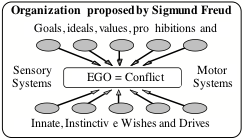
Few textbooks of psychology discuss how we choose what to think about—or how we choose what not to think about. However, this was a major concern to Sigmund Freud, who envisioned the mind as a system in which each idea must overcome barriers. Here is how he once envisioned a mind:
"... a large anteroom in which the various mental excitations are crowding upon one another, like individual beings. Adjoining this is a second, smaller apartment, a sort of reception room, in which consciousness resides. But on the threshold between the two there stands a personage with the office of doorkeeper, who examines the various mental excitations, censors them, and denies them admittance to the reception-room when he disapproves of them. You will see at once that it does not make much difference whether the doorkeeper turns any one impulse back at the threshold, or drives it out again once it has entered the reception-room. That is merely a matter of the degree of his vigilance and promptness in recognition."[xviii]
Thus getting past that doorkeeper is not quite enough to reach consciousness. That only leads to the reception room, which he sometimes calls the "preconscious."
"The excitations in the unconscious, in the antechamber, are not visible to consciousness, which is of course in the other room, so to begin with they remain unconscious. When they have pressed forward to the threshold and been turned back by the doorkeeper, they are 'incapable of becoming conscious'; we call them then repressed. But even those excitations which are allowed over the threshold do not necessarily become conscious; they can only become so if they succeed in attracting the eye of consciousness."
Freud imagined the mind as obstacle course in which only ideas that get past all those bars are awarded the title of consciousness. In one kind of block that he calls "repudiation," an idea is deliberately condemned—and thus is rendered powerless—although one can remember rejecting it. In another type, which he calls "repression," an impulse is blocked at an earlier stage—without the thinker knowing this. However, repressed ideas can still persist, expressing themselves in clever disguises.
Inside Freud's three-part model of mind, many resources are working at once—but they don't always share the same purposes. Instead, that mind is a battleground between animal instincts and social constraints. These are frequently incompatible, so the rest of the mind must struggle to find acceptable ways to compromise—and that’s often accomplished by subterfuge. One way to deal with a constraint is to suppress the resource that imposes it. Another is to disguise or re-describe it so that it arouses no Censors or Critics. Freud used the term sublimation for this; we sometimes call it 'rationalizing'.
Few modern ‘cognitive psychologists’ appreciate Freud's architectural concepts. He was one of the first to recognize that we deal with everyday problems in ways that are more complex than any one centralized process could. Instead, he saw the human mind as the product of diverse activities, many of which become engaged when we face conflicts and inconsistencies. Resolving these will often involve many different processes—to all of which we give vague names like Conscience, Emotion, and Consciousness.
∞∞∞∞∞∞∞∞∞∞∞∞∞∞∞∞∞∞∞
§3-7. Controlling our Moods and Dispositions
“Love, he believed, made a fool of a man, and his present emotion was not folly but wisdom; wisdom sound, serene, well-directed. … She seemed to him so felicitous a product of nature and circumstance that his invention, musing on future combinations, was constantly catching its breath with the fear of stumbling into some brutal compression or mutilation of her beautiful personal harmony …”—Henry James, in The American.
In §1-2 we described some ways that a person's state of mind might change:
"Sometimes a person gets into a state where everything seems to be cheerful and bright—although nothing outside has actually changed. Other times everything pleases you less: the rest of the world seems dreary and dark, and your friends complain that you seem depressed."
If you could switch all your Critics off, then nothing would seem to have any faults. You'd be left with few worries, concerns, or goals—and others might describe you as elated, euphoric, demented or manic.
However, if you turned too many Critics on, you'd see imperfections everywhere. Your entire world would seem filled with flaws, engulfed in a flood of ugliness. If you also found fault with your goals themselves, you'd feel no urge to straighten things out, or to respond to any encouragement.
This means that our Critics must be controlled: If you turned too many on, then you’d never get anything done. But if you turned all your critics off, it might seem as though all your goals were achieved—and again you wouldn't accomplish much.
Nevertheless, in everyday life there remains a wide range in which it is safe to operate. Sometimes you feel adventurous, inclined to try new experiments. Other times you feel conservative—and try to avoid uncertainty. And when you're in an emergency (as when you face danger or aggression), you don’t have time to reason things out, so you have to make quick decisions without considering most other factors. Then you’ll have to postpone long-range plans, suspend some relationships with your friends, expose yourself to stress and pain, and make other choices you’ll later regret. To do this, you'll have to suppress your suppressors—and then you may seem like a quite different person.
We use terms like 'disposition' and 'mood' to describe someone's overall state of mind. But terms like these are hard to define, because a person’s present state involves so many processes. Some of these change the ways we perceive, while others affect which goals we'll select, which strategies we’ll choose to use, and what degrees of detail we’ll focus on. Yet other processes turn our thoughts from one mental realm to another, so that first one may think about physical things, then about some social concern, and then about some longer-term plan.
What determines the spans of time that our minds spend in each dispositional state? Those intervals span an enormous range. A flash of anger, or fear, or a sexual image may last for only a very brief moment. Other moods may last minutes or hours—and some dispositions persist for weeks or years. "John is angry" means that he's angry now—but "an angry kind of person" may describe a lifelong trait. The durations of such mental states could depend on how we regulate the rates at which we switch.
In §7-2 we’ll speculate about how our Critics might be arranged. To what extent are they independent—like demons that constantly survey the scene, waiting for moments to intervene? To what extent are they controlled by special, more centralized managers? How do we learn new censors and critics? How many critics have critics themselves to scold them for poor performances? Are certain minds more productive because their critics are better organized?
Now it is more than a century since Sigmund Freud raised questions like these—but they have been so widely ignored that we still have don’t have adequate answers to them. Perhaps this situation will change as we get better ways to see inside brains.
∞∞∞∞∞∞∞∞∞∞∞∞∞∞∞∞∞∞∞
§3-8. Emotional Exploitation
Whatever you may be trying to do, your brain may have other plans for you.
I was trying to work on a technical theory, but was starting to fall asleep. Then I found myself imagining that my rival Professor Challenger was about to develop the same technique. This caused a flicker of angry frustration, which blocked for the moment that urge to sleep—and enabled me to proceed with my work.
In fact, Challenger was not doing any such thing; he works in a totally different field. But although he was a close friend of mine, we had recently had an argument. So he served as an opportune candidate when I needed someone to be angry at. Let's make up a theory of how this worked.[xix]
A
resource called Work was attending
to one of my principal goals.
Another one called Sleep
tried to seize control—but then that fantasy appeared.
This aroused a mixture of Anger,
annoyance, frustration, and fear.
Somehow, these then had the effect of disrupting the process of falling asleep.
This sequence of steps established a state that counteracted the urge to sleep—and thus returned my mind to its 'working' state. We can see my use of that fantasy as having the effect of an emotional 'double negative': by using one system to switch off another.
Everyone uses such tricks to combat frustration, tedium, pain, or sleep. Here I used anger to keep myself working—but the same technique might serve as well, if one were falling behind in a race, or trying to lift too heavy a weight. By self-inducing anger or shame, you sometimes can counteract weakness or pain.
Note that ‘Self-control’ tactics need careful direction. Just a brief tweak might serve to stop Sleep --so slight that you don’t know you’re doing it. But if you don't sufficiently anger yourself, you might relapse into lassitude—whereas if you get yourself too incensed, you’ll completely forget what you wanted to do.
Here’s another example where part of a mind 'exploits' one emotion for the purpose to turning off another—thus helping you to attain some goal that you cannot achieve more directly.
Celia is trying to follow a diet. When she sees that thick, rich chocolate cake, she is filled with a strong temptation to eat. But when she imagines her friend, Miss Perfect-Body, looking gorgeous in her new bathing suit—then Celia’s passion to have that same shape keeps her from actually eating the cake.
What is the role of that fantasy? Celia's procedure for ‘dieting' does not include any straightforward way to suppress her reckless appetite. However, the emotion that we call Disgust is already designed to do just that (by backing-up one's digestive tract) and, somehow, Celia has trained herself to react in that way when she thinks of her shape. When the sight of her rival arouses that image, she'll have less desire to eat that cake. But that strategy is not without risk: if Celia's jealousy makes her depressed, she might engorge the entire cake.
Why should fantasies have such effects, when we 'know' that they aren’t real? Surely, this must be partly because each mind-part sees only a few other parts, which serve as its private reality. We never directly see the world; that’s just another Single-Self myth. Instead, although some parts of your brain directly react to what your external senses provide, most of them must base their representations on information that they receive from other, internal brain-resources.
For example, when you sit at a table across from a friend and assume that she still has a back and some legs, you're using old models and memories. It's the same for the chair that she's sitting on. None of those things now lie in your sight, yet it’s almost as though you can see them. Fantasy is the missing link. In {Imagination} and in {Simuli}, we'll see how machines could imagine such things.
Student: I know that we all have fantasies, but why did such strange ways of thinking evolve? Why can’t we just figure out what to do in a perfectly rational way?
My answer is simply that there's no such thing; that popular concept of ‘rational’ is itself just one more fantasy—that our thinking is ever wholly based on pure, detached logical reasoning. It might seem somewhat ‘irrational’ to exploit an emotion to solve a problem. Our culture teaches us to believe that thoughts and emotions are separate things. But this makes no sense from the viewpoint of Work: when it can’t control a resource that it needs, this will appear from Work’s point of view to be just an additional obstacle. So far as your agents for Work are concerned, exploiting Anger to turn off Sleep is like using a stick to extend one’s reach. No matter that when this is seen from outside, it appears to be "emotional”: to Work this need not seem anything than another way to achieve its goal. We're always exploiting fantasies in the course of our everyday reasoning, and we all use such tricks for 'self-control'”
To stay awake, you can measure out the right amount of some stimulant. You can pinch yourself to produce some pain; or adopt an uncomfortable posture, or take a deep breath, or just set your jaw. You can move to a more exciting place, or indulge in a strenuous exercise. Or, you can make yourself angry or afraid—by imagining that you have failed.
A major part of our daily lives consists of these kinds of activities. It's customary to assume that it’s ‘you’ who is choosing to do them. But often they come from small parts of your mind that are trying to change their environments. We need to imagine fictional things whenever we solve a geometry problem, or look forward to a forthcoming vacation. Whenever we think, we use fantasies to envision what we don't yet have, but might need. To think about changing the way things are, we have to imagine how they might be.
Student: Again, I agree that we do such things—but again, I cannot help wondering why. Why cannot Work just turn off Sleep, but must use such indirect methods? Why do we have to tell lies to ourselves, by inventing illusions and fantasies—instead of simply commanding our minds to do whatever we want them to do? Why doesn’t Work have better connections?
One answer seems clear: Directness would be too dangerous. If Work could simply turn Hunger off, we’d all be in peril of starving to death. If Work could directly switch Anger on, we might find ourselves fighting most of the time. If Work could simply extinguish Sleep, we'd be likely to wear our bodies out. This is why it's distressing to hold your breath, and why it's so hard not to fall asleep—or to take control over how much you eat. Few animals that could do such things would live to have any descendants. Consequently, our brains evolved ways to keep our minds from meddling with the systems that work to keep us alive. Hence, we can interfere with those processes, only by becoming devious. We can’t simply suppress the urge to sleep—but eventually, we discover some tricks that can do this by using indirect methods.
For example, here Work has no direct way to stop Sleep, but has learned that Anger undermines Sleep. And while Work has no direct way to activate Anger, it has learned that a certain fantasy can arouse Anger. So if Work can somehow activate that fantasy, then Anger will start to inhibit Sleep, and Work will be able to get back to work.
Student: Your theory suggests more questions than it answers. How could Work manage to learn such a trick? How are those fantasies produced? How are those memories retrieved? How can a fantasy make you angry? How does Work induce that fantasy? How does Anger inhibit Sleep? And why do we need to sleep at all? Considering how much time it wastes, and all the inconvenience it brings, why did we ever evolve such a thing?
§5-8 Simuli will talk about how machines could make fantasies, §6-2.2 Remembering will consider how memories might be retrieved, and §9-2.1 Self-Control will discuss how Work might learn to use such a trick. As for why we need to sleep at all, it is strange how little we know about this. Recent research suggests that it plays important roles in how we learn, but clearly, sleep serves other purposes. It is common in evolution that whenever some new kind of function appears, other systems evolve new ways to exploit it. Thus once a first form of sleep evolved, other functions were found for it—perhaps for renewing depleted resources, for repairing damage to organs, or, perhaps for imagining things without exposure to external risk. So, we should not expect to find one reason for all the many aspects of sleep—or for any other mental function.
Student: How does Anger inhibit Sleep in the first place?
That must involve ancient machinery. We're born with great systems of built-in connections that help us recognize dangers, failures and other sorts of emergencies. These 'alarms' have connections to other resources, such as the “Emotion-Arousers” of §1-6, which can drive into those great cascades—like anger, anxiety, fear, or pain—that can reset all our priorities. [See §§Alarms.]
Student: You haven't discussed how Anger works.
One theory could be that the state we call ‘Anger’ suppresses some of our more thoughtful resources—so that we become less 'reasonable'. Then we tend to make more quick decisions, and thus are disposed to take more risks. It is tempting to think of such a person as erratic and unpredictable. Yet paradoxically such persons become, in certain ways, more predictable than they’d normally be—and that can have a useful effect: when you are angry and express a threat, your opponent may sense that you won’t change your mind—because you are no longer ‘reasonable.’ The effectiveness of apparent threats depends on convincing antagonists that one truly intends to carry them out. If you can make yourself think that your threat is real, this can help you to display the emotional signs that will make your opponent believe it, too!
Critic: Not all types of anger cause rapid decisions. When Charles flies into a sudden rage, and punches someone who taunted him, his decision is quick—and he takes a big risk. But when Joan is chronically angry about the destruction of rainforest habitats, she may become deliberate and methodical at raising funds for saving them.
Our adult emotions continue to grow into ever more convoluted arrangements. As we age, we can train our emotional states—and modify their outward signs—till they no longer resemble their infantile shapes.
Physiologist: Anger is not just a state of mind; it also raises your muscle tone, fires you up with energy, and speeds up your reaction time. This involves the body and not just the brain.
Certainly, Anger engages many bodily functions; it can affect your heart rate, blood pressure, breathing, and sweating. However, when seen in the Cloud–of–Resources view, there is nothing special about such connections; the body itself then appears as just one more set of resources to exploit. (And quite a few of those same effects will occur if you simply hold your breath.) For, it is easy to see why such systems evolved: anger helps us to prepare for certain and emergencies—such as fighting, defense, and intimidation. However, we should not too closely identify these with how Anger changes one’s Ways to Think; it is true that these interact with those somatic effects, but yet are far from being the same sorts of things. [See §§Embodiment.]
TRANSITION?
∞∞∞∞∞∞∞∞∞∞∞∞∞∞∞∞∞∞∞