|
|
|
Perceptual Signatures:
- Perceptual signatures encode identifiers implicit in our facial features,
gaits, communication styles, behaviors, daily activities, etc.
- Perceptual signatures research has produced innovative algorithms based on
statistical machine learning and numerical tensor algebra for extracting
perceptual signatures from large datasets, generated by individuals or groups of
people, corporations, government agencies, terrorist cells, etc.
- Perceptual signatures come in a variety of forms, such as a spending
profile that banks can use to identify fraudulent spending, a characteristic
gesture that comedians exploit, a human motion signature for computer animation,
a facial signature that can be identified by keyless access systems, etc.
|
Biometric Computing using Perceptual
Signatures:
Perceptual signatures distilled from biometric data is fundamental to
human-centric technologies such as the burgeoning security industry, but when
directed at ourselves, biometric technologies can serve as reflectors that
enhance our self-awareness, understanding, and health, and they can facilitate
our interaction with each other and computers.
- Reflective Biometrics distills biometric data to perceptual
signatures for self-surveillance. This can enable self-monitoring (the sci-fi
Heechee Saga - the future for at-home health care.) Self-surveillance systems
can become instruments of the individual.
Reflective biometrics research is the self-examination via technology as a
mirror.

-
TensorFaces
for recognition is an individual's identifier extracted from unconstrained
facial images that can confuse and mislead facial recognition systems. Tensor
representations of facial images enable robust facial recognition under
unconstrained viewpoint, illumination, expression, and other conditions.
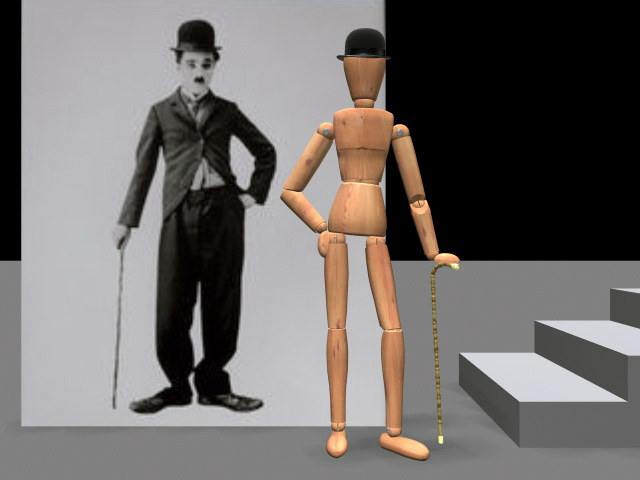
- Human Motion Signaturess is a quantitative model of human motion that
can be used to identify an individual or characterize the gait as normal versus
pathological. Multilinear algebra is applied to the nonlinear representation,
analysis, synthesis, and recognition of human movement from perceptual data.
|
|

